
When Summer Breaks Your Routine, It Breaks Your Defenses Too
The riskiest clicks don’t happen when you’re focused. They happen when you’re juggling.
School let out a few weeks ago, and the workday looks different now. Maybe you’re starting at 6 a.m., so you can knock off by 3 and get the kids to swim practice. Maybe you’re working from the kitchen table while someone watches cartoons in the next room. Either way, the rhythm has shifted.
So has the rhythm of the people trying to break into your systems.
What actually changes in the summer
Phishing attempts don’t suddenly get more sophisticated in June. They get better timed. When your attention is split — between a client call, a kid asking for a snack, and a vendor email that needs a same-day answer — you’re reading messages faster and questioning them less.
That’s the window. Not a moment of carelessness. A moment of normal busyness.
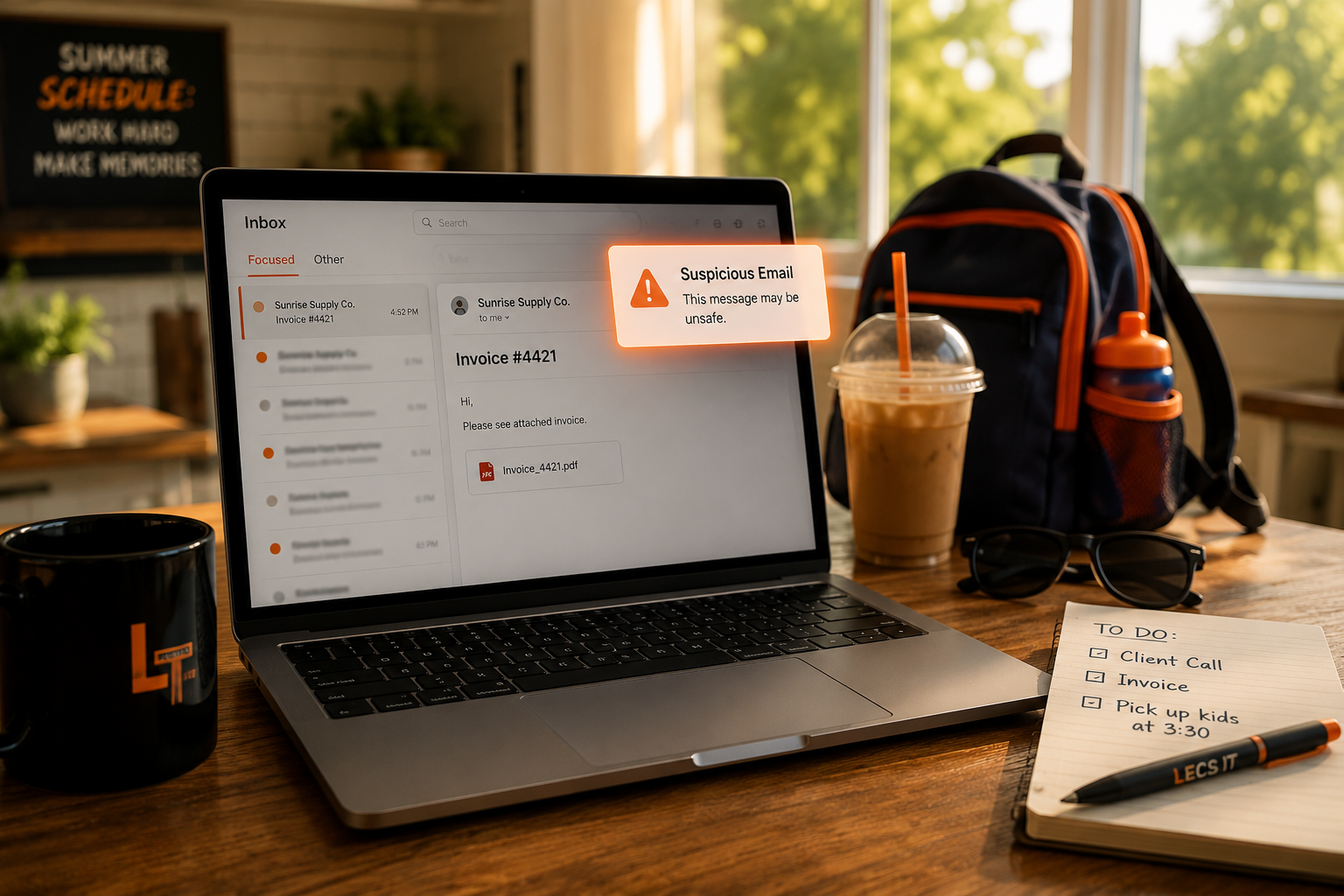
The emails that land in those moments look ordinary. A shared file from someone you work with. An invoice that matches a vendor you actually use. A quick request from someone claiming to be your boss, sent at 4:55 p.m. on a Friday. Nothing dramatic. Nothing that screams “scam.” That’s the point.
The click isn’t really the problem
When someone on your team clicks the wrong link or opens the wrong attachment, the click itself is a small event. What it opens up is not.
Most small businesses in Northern Indiana run on connected systems — email, shared drives, accounting software, customer records — that all talk to each other. Once one account is compromised, the path to the rest is shorter than people think. By the time anyone notices something is off, the issue has usually moved well past where it started.
The honest version is this: you can’t train your way out of it. Telling people to “be more careful” assumes they have time to evaluate every email like they’re defusing a bomb. Between Plymouth, Warsaw, and Goshen, we work with business owners who run payroll, answer customer calls, and make sales decisions in the same hour. Asking them also to be a full-time threat analyst is unrealistic.
What actually works
The goal isn’t perfect human behavior. It’s making sure that when someone does make a mistake — and someone will — the damage is contained.
A few things make a real difference:
• Unique passwords for every login, so one compromised account doesn’t open the rest
• Multi-factor authentication on anything that matters, so a stolen password isn’t enough on its own
• Email filtering that catches the obvious junk before it ever reaches your team’s inbox
• A clear, low-friction way for someone to ask “Does this look right?” without feeling like they’re bothering anyone
None of this depends on your team being on high alert every minute of every day. It’s built for real workdays where people are moving fast and getting interrupted.
When to bring in help
If you’re not sure whether your current setup would catch a bad click before it became a bad week, that uncertainty itself is the answer. The businesses we talk to in Michiana usually fall into one of two camps: they’ve put the guardrails in place and don’t worry much about summer, or they’re hoping nothing happens until things calm down in the fall.
Hoping is not a plan.
If you’d like to see what your business actually looks like from a security standpoint — what’s protected, what isn’t, and what’s worth fixing first — book a quick call: http://os.lecsit.com/l/disoverycall-june-2026-blog. Or call us at 574-857-4332.